
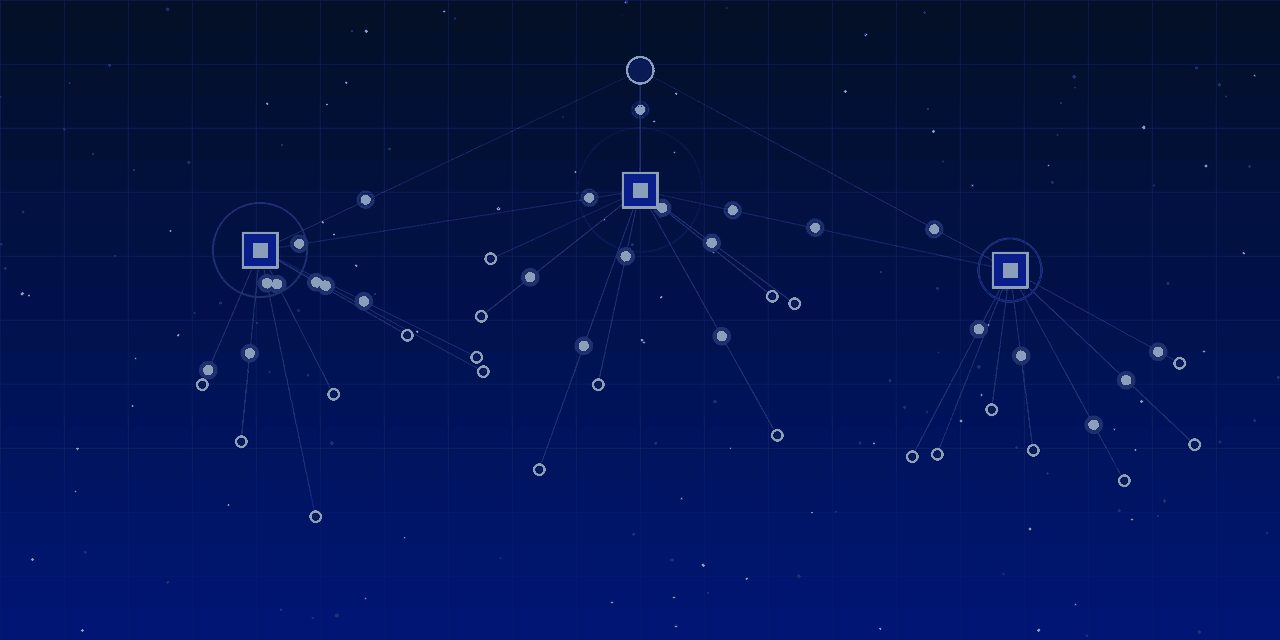
Spatio-temporal perception model
A probabilistic model that jointly assesses the sensing reliability of different devices over space and time, so that each sensing task is assigned to devices able to observe the area of interest.
A context-aware orchestration framework that composes perception, actuation and edge-computing components into IoT applications running over mobile ad hoc networks.
Mobile ad hoc networks (MANETs) operate without fixed infrastructure. Devices move, links form and break, and the reliability with which a device can sense its surroundings depends on where it is. IoT applications built over such networks cannot rely on a fixed set of devices or a stable network.
The project develops a context-aware orchestration framework that combines perception, actuation and edge-computing components into IoT applications over MANETs. Composition decisions account for the spatial context of each device, its sensing reliability with respect to the area of interest, and the expected state of the wireless network and edge servers.
Each application request is divided into finer sub-requests, so that the composition can adapt in real time as devices move and conditions change.
The framework has three components, which together decide which devices and edge resources serve each part of a request.
A probabilistic model that jointly assesses the sensing reliability of different devices over space and time, so that each sensing task is assigned to devices able to observe the area of interest.
Machine-learning predictors of changes in wireless conditions, edge-server load and device availability, so that compositions anticipate changes rather than only react to them.
Optimization and metaheuristic algorithms (column generation, ant colony optimization and particle swarm optimization) that divide each request into finer sub-requests for real-time adaptation.
A prototype of the framework will be evaluated in simulated environments representative of industrial fields and healthcare infrastructure in Kuwait.
The project combines probabilistic modeling, machine learning and discrete optimization.
Department of Computer Science.
Montreal, Canada.
Department of Computer Science.
Department of Computer Science.
 Supported by the Kuwait Foundation for the Advancement of Sciences (KFAS) through an Applied Research Grant.